
To and Through the UTMB Kodiak 100-Miler – Cory Fleming’s Biggest Race with a J Pouch
By Cory Fleming
As the cliché goes, you have to know the past to understand the present. So let’s start there.
Six years ago, I ran a 100-mile race called Tunnel Hill. Set on a perfectly groomed rail trail in rural Illinois, the course is famed for being flat and “easy” – well, if any 100-miler can be. I was a novice runner, with not two years’ worth of lifetime miles in me, and the race was simply a bucket-list item: a one-time thing, just to say I did it. I doggedly dragged myself across the course in a respectable time, destroying my severely underprepared legs in the process. My gut was also in shambles throughout that race, but if you can count on runners for anything, it’s complaining about GI issues. So I figured this just came with the territory.
It turns out I was wrong. I ran those 100 miles with undiagnosed ulcerative colitis, in the midst of a flare-up, literally gutting out each split while painfully unaware of the condition that would shape my life to come. I was also unaware that I’d toe another 100-mile start line six years later, missing a major organ yet somehow significantly stronger. Here’s the tale.
A quick trip through five years
To avoid repeating much of what I’ve already strewn across this site, I’ll keep the background short. I was diagnosed with ulcerative colitis in April 2021. After making it through a severe flare-up that ended in May, the disease let up, and I enjoyed six normal months. Toward the end of 2021, though, another flare-up took hold, and from then on, I couldn’t manage the condition. I tried the most efficacious drugs; I made every dietary change; I did everything I thought possible, guided by one of New York City’s best doctors, all to no avail. Still, I trained the best I could throughout it all, with triathlon as my preferred endurance sport at the time. Compromised, inconsistent training was better than no training.
In April 2023, only two years from my diagnosis, my doctor had seen enough: I would go through the multi-step surgical process of having my large intestine completely removed and my small intestine formed into a “J pouch” to fill its place. I made it through the surgeries and got my J pouch, but just barely. My body had an extremely rare but severe reaction to one of the procedures, leading to an unplanned emergency surgery that saved my life but left me apartment-bound for four and a half months, hooked to a feeding tube for 12 hours a day and recovering from essentially being sliced in half. Those were dark times, but I came out the other side absolutely driven.
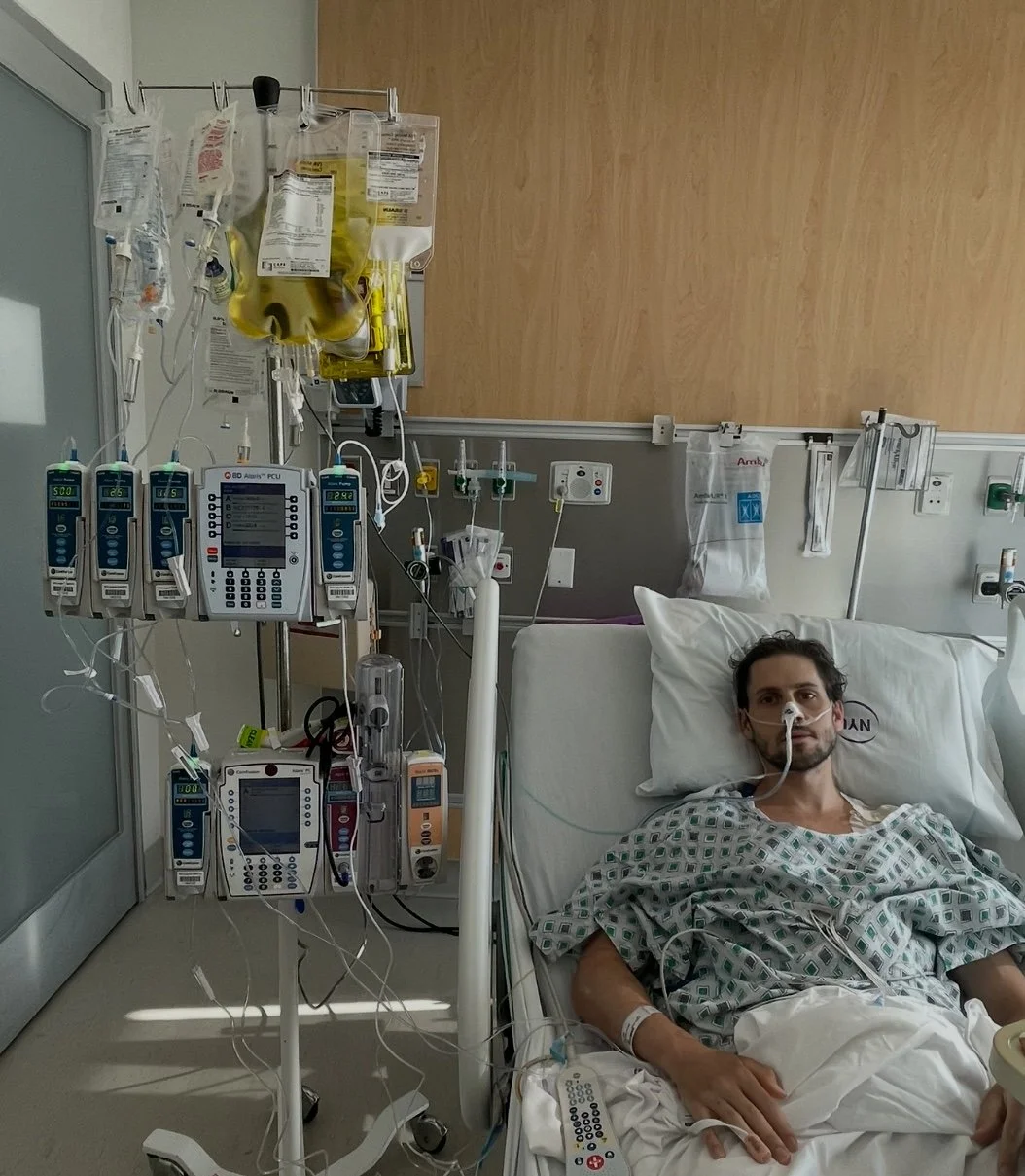
Cory hospitalized in 2024
Against the odds, in January 2024, I had my final surgery and my J pouch was functional. I was off the feeding tube, and I would soon be cleared for exercise. I tested the limits of this newfound freedom and, insane as it was, finished Ironman Lake Placid – a triathlon with a 2.4-mile swim, a hilly 112-mile bike, and an undulating 26.2-mile run – only six months later. Six months is hardly enough time to return to basic, everyday tasks with a J pouch, but I’ve always had a penchant for the extreme.
I continued with triathlon, and my body continued to improve. Early in 2025, my wife Natalie and I moved from NYC to Los Angeles, close to where I grew up. Tempted by the surrounding mountains, I soon traded triathlon for trail running. I fell in love with the sport immediately and had a certain aptitude: I raced a local 100k and two local 50ks in my first year, and won them all outright. So, come April 2026, I figured hey, let’s see how I hold up over a real 100 miles. I signed up for the Kodiak 100-miler, a race organized by UTMB, which runs the world’s premier trail running circuit. The start was scheduled for October 9th of this year.
Getting to Kodiak
The Kodiak course is nothing like the Tunnel Hill 100 I ran all those years ago. It navigates the high mountains surrounding Big Bear Lake in Southern California, with an average altitude over 7,000 feet and a peak of about 10,000 feet. Rather than a flat, groomed trail, Kodiak holds around 16,000 feet of elevation gain and a similar amount of loss, and traverses plenty of rugged singletrack along the way. Twelve hours of the race would be in the dark, lit by my headlamp and really testing my nascent trail running skills. I couldn’t wait. And as a bonus, Kodiak is UTMB’s Americas Major, so it’d be sold out, competitive, and offer a handful of qualifications for 2027’s edition of the most famous race in trail running – the UTMB, a massive race out of Chamonix, France, that loops around the Mont Blanc massif. Running UTMB’s namesake race is a dream of mine.
I began proper training for Kodiak in mid-April, right as I was starting a demanding new job. To manage it all, I took a machine-like approach to each day, fitting two workouts into most weekdays amidst a whole lot of work. On weekends, I was free to get out to the mountains for a longer run, often two. Most weeks, I aimed to run 70-80 miles with 12,000-16,000 feet of vert, mostly easy but with one or two harder sessions. I also fit two short lifts in each week, with one focused on muscular endurance, plus about three to five hours of easy spinning on the indoor bike. I’m self-coached, so I planned and designed every session. Along the way, I managed to win and set the course record at the Malibu Canyon 50k in June. I also took a week of vacation in July to cycle and run all around LA with a good friend visiting from NYC.
With my health better than ever and my J pouch cooperating, this was the best training block of my life. Between mid-April and early October, I ran over 1,600 miles with more than 300,000 feet of gain and loss, and my consistent strength work and cycling complemented the run volume. I couldn’t have done more: this was about as ready as I could be for Kodiak. I drove to Big Bear with my crew – Natalie and my parents – and after an iffy night of sleep and a relaxing morning, I was suddenly on the starting line.
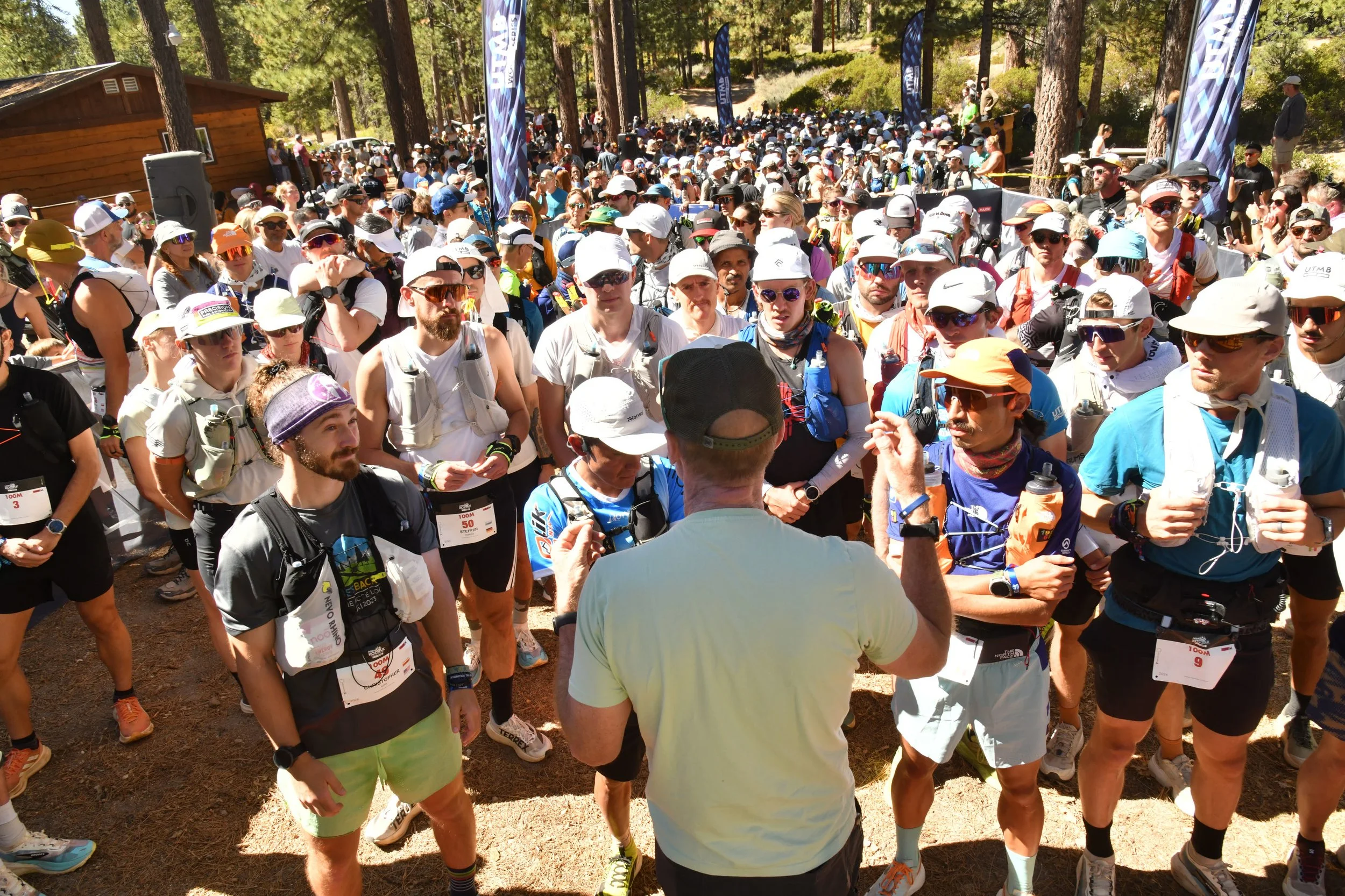
Final race instructions
The race
I lined up in the elite corral with the pros as well as any amateurs aiming for a top spot in their age group or an overall top 10 in their gender. Truthfully, I didn’t know exactly what to expect from myself: I was in incredible shape, but 100-milers test durability built through lifetime miles, and my running history was inconsistent and thin even compared to other amateurs. Still, if things went remarkably well, I figured I could finish the race in under 20 hours. Where that would place me, who knows – I’d focus only on myself and my own effort.
Between the strong 1:00 pm sun and the unrealistic pace most runners take off at, I let much of the field go ahead as the metaphorical gun sounded. I positioned myself around 30th overall and kept the effort light, but my pace was high enough to hold my spot through the initial patch of singletrack. For the first several miles, I enjoyed the trails, followed the bodies in front of me, and tried to keep my heart rate down. I had my headphones going and a long playlist on deck, full of recs from my friends over at The Progressive Subway, where I review albums in my free time. Once I hit the first aid station eight and a half miles in, I was running steadily ahead of plenty of folks who had started in front of me.
I focused on my hydration and nutrition, aiming for 75-100 grams of carbs per hour. I also felt for any signs of chafing or discomfort from my kit, but there were none. Rabbit, a women-founded independent running brand based in Santa Barbara, had sent me a full kit for the race. Despite only having time to test it on a short run around the block, I put full trust in Rabbit. The kit was excellent: pure comfort from start to finish, which is quite the feat over the 100-mile distance. Rabbit is exactly the type of brand that resonates with me and that I’m proud to wear.
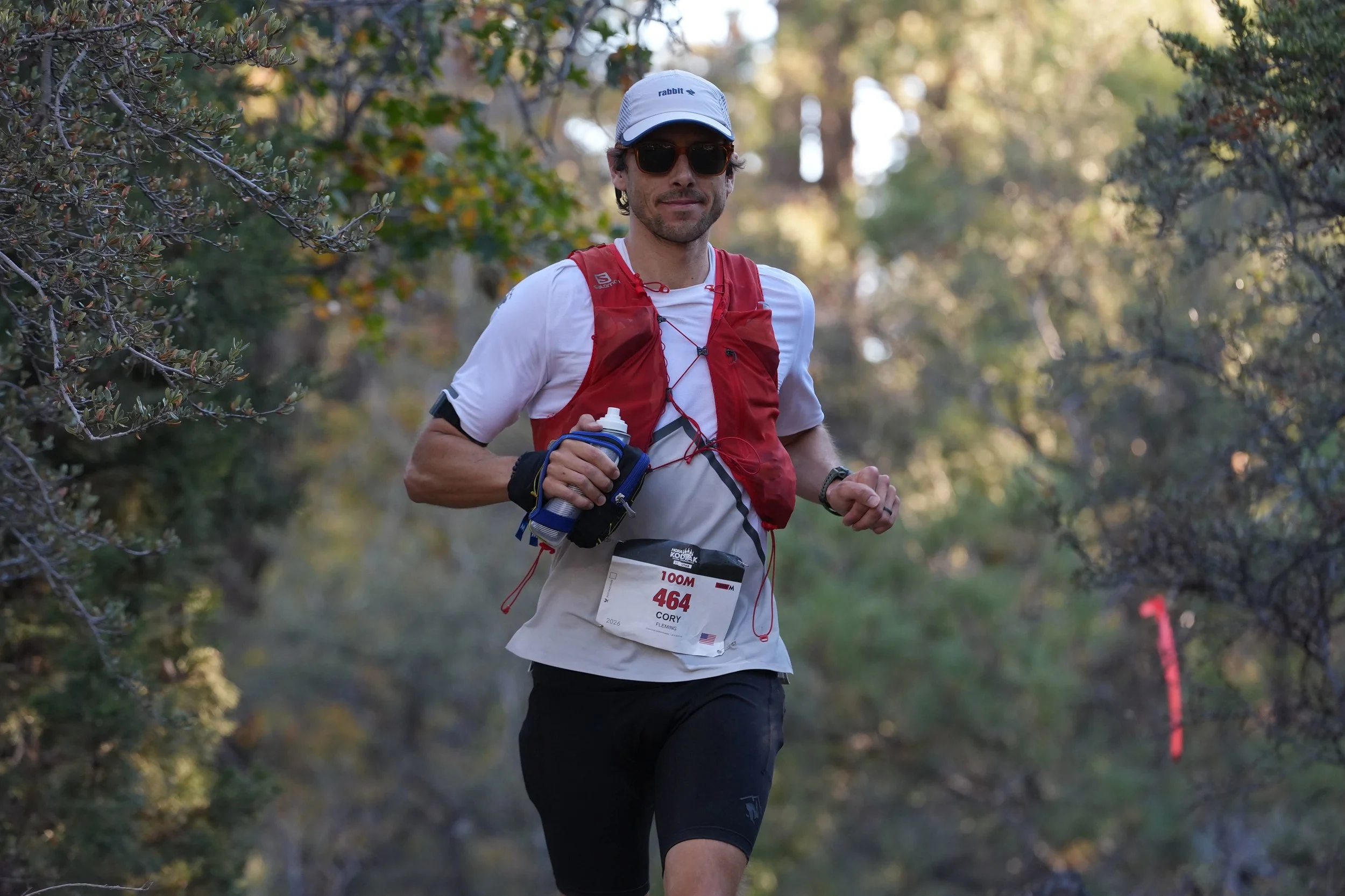
Cory finding his rhythm
Turning the legs over on the descents and hiking or jogging the climbs, I cracked along at a reasonable pace, picking off competitors one by one. I didn’t have a sense of what place I was in, but that was ok – again, it was all about my own effort. By mile 25, though, I started feeling a bit worn down. The day’s first low came earlier than expected. It’s easy to have doubts that early on, but instead of spiraling, I thought back to something the 2025 Ironman World Champion triathlete Solveig Løvseth spoke about. During the run leg of her championship performance, her first few miles felt surprisingly tough – how would she hold pace for another 20-plus miles? But she found that the pain didn’t change much as the race got deeper. It was all painful, and that was fine: she could manage it the whole way through. I was managing the discomfort I felt at 25 miles just fine; there was no reason I couldn’t keep managing it and pushing forward.
An aid station around mile 35 was my first opportunity to see Natalie and my parents. As my crew, they helped as I switched my hat out for a headband, put on a headlamp, and restocked on hydration and carbs. Less conventionally, they also handed me a travel bidet as I headed to the porta potties – I bet they were the only crew carrying one of those! As you can imagine, running without a large intestine comes with unique challenges. But my gut had held together well enough so far, which was a testament to all the fueling strategies I had tested and practiced in the months leading up to the race. Taking a few trips to the bathroom is nothing, all things considered. I headed off as the sunlight was fading, in a great state of mind after seeing Natalie, Mom, and Dad.
I carried on through the night at a decent clip, making my way across some of the course’s most runnable miles. Before I knew it, I had crossed the 50-mile mark. My watch read a few minutes under eight and a half hours elapsed, meaning I was killing it. I was technically on pace for a 17-hour race, but it’s virtually impossible not to slow down in the back end of a 100-miler; and in any event, the course’s second half is much tougher than its first. I figured I realistically was on pace for a little under 20 hours, just as I wanted. I came upon another aid station, where a volunteer mentioned I was in the top 10, but her intonation was halfway between question and statement. Still, that gave me renewed life just as I was beginning to fade.
Some miles later, I made it to the second aid station my crew could access, and Natalie confirmed I was in ninth place. Nice! I hurried off, giving her a kiss and saying goodbye to my parents. The next segment looped back through an area I had run earlier, which was now filled with runners a few hours behind me. The last 40 miles had been practically solo, so I welcomed having some people to chase. Better to feel like the hammer than the nail. I found one runner who was also on his second trip through, and so when I ultimately dropped him, I knew I was in eighth place.
The toughest stretch of the course, by far, came between miles 65 and 78. Although only a half marathon in length, I took three and a half hours to cover that section. The initial climbs were extremely steep and technical, with terrain hardly resembling a trail. Then, after a quick stop for my final of only four bathroom breaks (not bad for a J pouch!) and a chance to see my crew, the course took me to the summit of Sugarloaf Mountain, which tops out almost exactly at 10,000 feet. Naturally, my headlamp’s battery decided to die right at the near-freezing peak, making the battery swap particularly tough with shaking hands. Between the climb up and descent down Sugarloaf, I bashed my knees together, tripped several times, and destroyed my poor toes by kicking countless large rocks. I tried to eat a massive Rice Krispies bar my dad had given me at the base of the climb, but my mouth was too dry, so I awkwardly carried the damn thing in my vest. I wasn’t eating enough, and I felt slow, as if my sub-20-hour goal were slipping away. On the positive side, I moved into seventh place. But during an out-and-back part of Sugarloaf, I could see that eighth through tenth weren’t far behind. I’d have to stay on the gas.
I finally hit a long, runnable descent, and my legs clicked into gear. Sure, I was only running a pace slightly under nine minutes per mile, but it felt like flying relative to the long slog that came before. The descent ended, and relentless forward progress became my trite but apt mantra. I knocked out each mile without much thought, stopping only to grab hydration, fuel, and a bit of love from my crew. Time moved quickly, and all of a sudden I was more than 90 miles in. The sun began to rise.
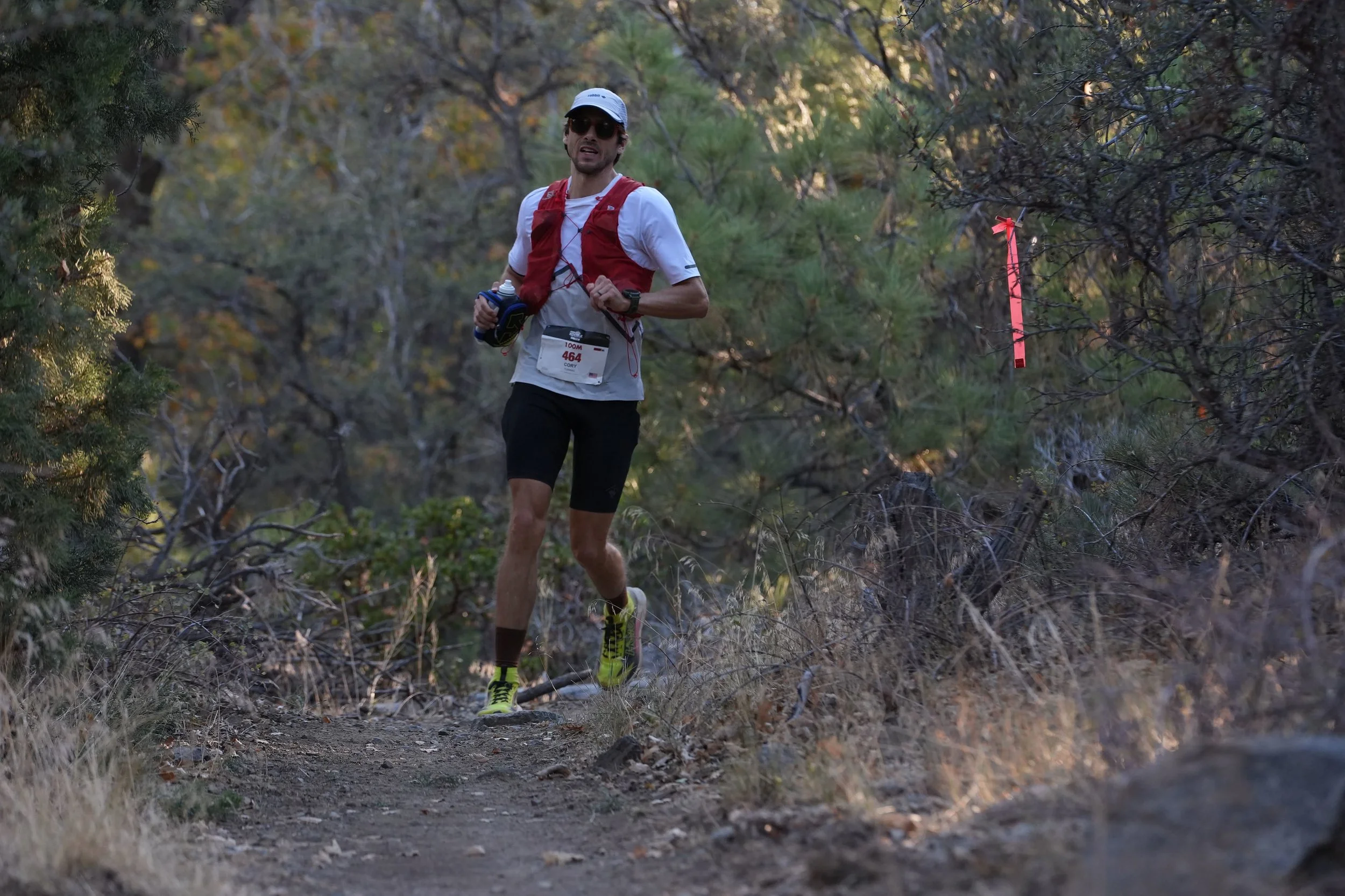
Cory on the single track
The sunrise was beautiful, I’m sure, but I was too busy looking at the trail beneath me, trying to navigate a technical singletrack descent. I kicked the hell out of another rock and was confident I had broken off a toenail or two. Once that descent finished, the final test began: a sharp push up a ski slope. After that climb, it was just a runnable four and a half miles down to the finish.
At the base of the ski slope, the runner in eighth place caught me. As he passed, we exchanged some nice words, and I almost wished he’d create a big gap so I could let him go rather than chase him and suffer to the finish. But instead, I followed him step for step up the huge hill, both of us laboring in silence. When we reached the peak, he went inside an aid station, and I decided to save time by quickly taking whatever drink mix a volunteer outside was holding. This bought me a gap of 20 seconds or so as we began the descent to the finish.
To my surprise, I started pulling away. Running downhill on trashed quads is one of the more difficult parts of ultras, but my legs were up to the task. My watch passed the 100-mile mark, and I calculated I still had a mile and a half to go – I had been warned the course ran a tad long. Dirt turned to pavement, and soon I was in the finishing chute. One of the shorter Kodiak races was about to begin right where I was finishing, so hundreds of runners were there to cheer me to the line, as were Natalie and my parents. I crossed in 19:37:55, a shattered but very happy man. I had come in seventh place in a field of 428, an unbelievable result thinking back to Tunnel Hill and the intervening years.
Post-race
As usual, there was no flood of emotion or profound revelation, just pain. My right knee was swelling up, and my left big toe felt mangled. The full-body agony that follows 100 miles was present too, of course. I limped over to a tent where a race organizer made sure I had my mandatory gear – we had to carry several safety items the whole race, or else face penalties or disqualification. I had them all, and that made it official: my seventh-place finish qualified me to run the UTMB, the series’ namesake race and championship in Chamonix.
Natalie and my parents helped get me back to the cabin we had rented for the weekend, where I sat in some mix of pride and pain, trying to force down food while watching the Ironman World Championship that had coincidentally just started. Big Bear then treated us to a citywide power outage, but only for a few hours. We all went out to dinner, passed out, and packed up in the morning.
Before heading back to LA, we attended the race’s awards ceremony, where I joined others hobbling as badly as me up on stage to accept our prizes. I came away with a sweet wood-carved bear as a trophy, and more importantly, a reason to start planning a trip to Chamonix. What a success.
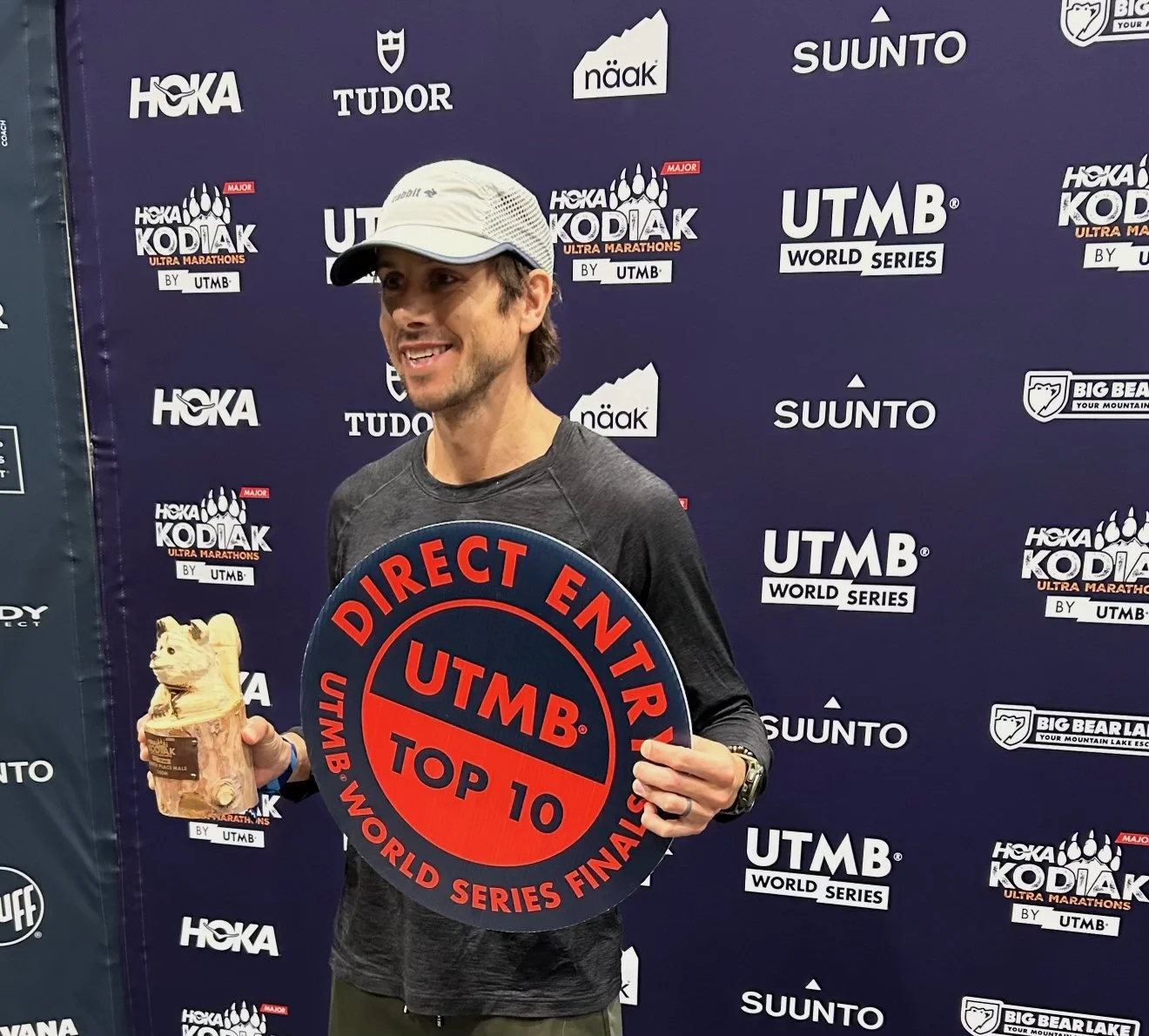
Cory receiving his award
Why do I do it?
Naturally, I have to ask myself – what’s the point of all this? There are a million reasons why I love trail running: striving for goals that seem impossible, being driven to do something each day, the accompanying process of physical and mental self-betterment, the list could go on. The more I think about it, though, the more it boils down to the life-affirming feeling of blasting some music and ripping a bunch of miles in the mountains. In a society obsessed with comfort and convenience, where each innovation aims to make docile lives even milder, there’s a refreshing lunacy to picking a peak off in the distance and running to it. The inherent suffering feels like a small act of rebellion.
A mere three years ago, I spent half of each day on a feeding tube, and the other half virtually bedridden anyway. The fact that I can now chase the elite field at a major 100-miler, even down a significant organ, seems unreal. I hope it offers some optimism to others who suffer from ulcerative colitis and Crohn’s disease; it’s so easy to let those conditions suck the life out of you. Fortunately, I’ve found a couple of other J pouchers who inspire me. Professional ultrarunner and all-around badass Alyssa Clark consistently competes at the pointy end of major races. And my friend and local legend Dave Odell is a father, grandfather, and CEO who bags a few huge ultras each year. He recently celebrated his 33rd wedding anniversary by racing 95 miles in the Alps with his wife; the two stuck together the entire race. With people like that out there, how could I not start each day ready to get after it?
* * *
I woke up at 3:00 am the morning after Kodiak, when I should have been in full hibernation. I was wide awake, partially because my body’s rhythm was totally out of whack, but mostly because I couldn’t stop thinking about racing UTMB next year – about my wife and parents taking the trip to Chamonix with me, sharing in the experience. That level of excitement is affirmation that I’ve found something that enriches my life far beyond what I thought possible only years ago. After gathering the strength to push through a long, dark road, the destination has been brighter than I ever could have imagined.